The Living With Water project was a collaborative, community-engaged research project conducted in partnership with the Duwamish River Community Coalition from August 2024 to January 2026. The project team worked with residents of the South Park neighborhood to identify and develop flood adaptation strategies that respect and incorporate local community values.
Background
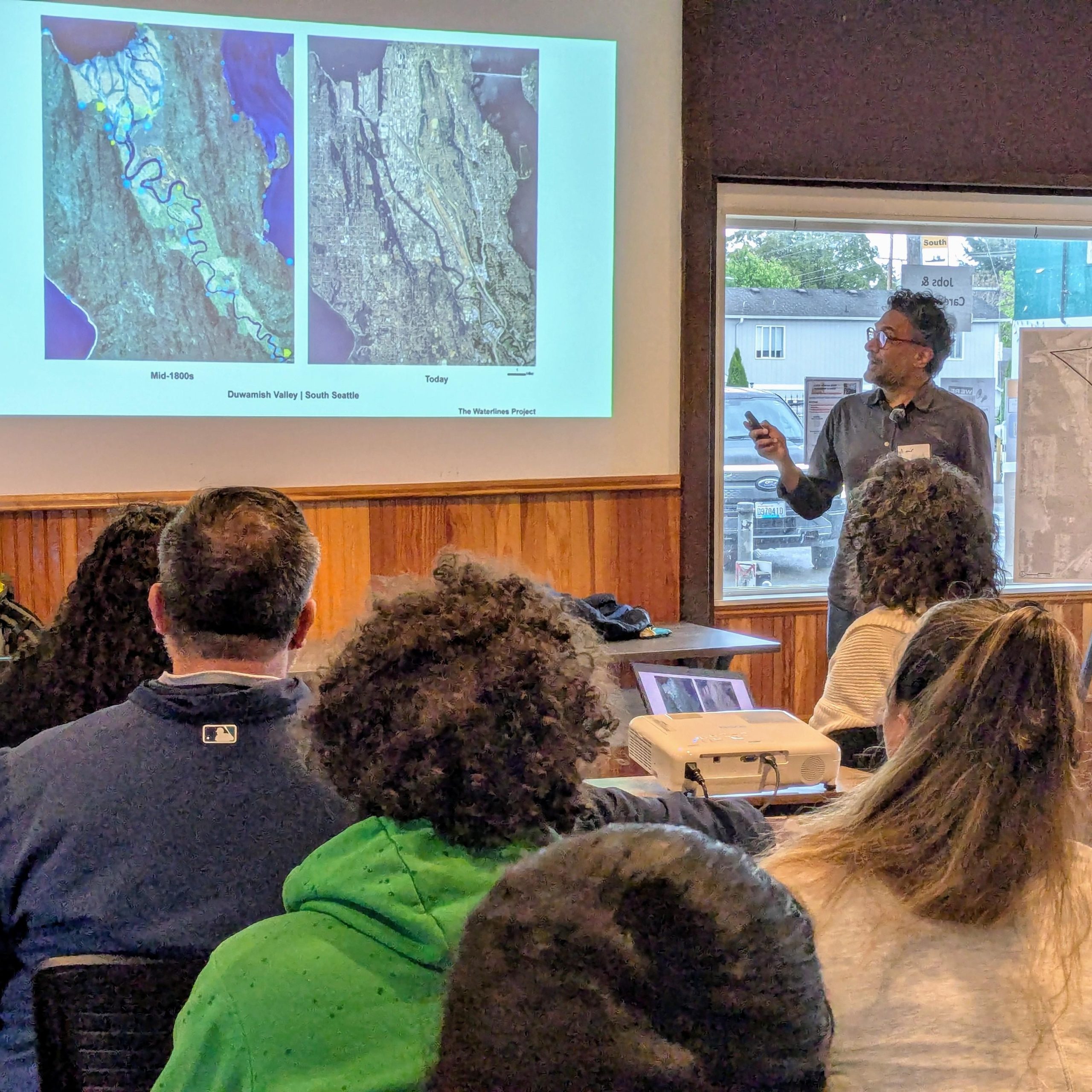 In December of 2022, a “king” tide on Seattle’s Duwamish River during heavy rains caused flooding that damaged more than 40 households in South Park. The flood happened just as the Duwamish River Community Coalition (DRCC) had finished a door-to-door survey with the University of Washington (UW) and local and state government partners in order to understand community strengths and weaknesses in the face of climate change.
Intensified future flooding in South Park is expected due to sea level rise and bigger storms resulting from climate change. To help guide planning efforts, DRCC and UW designed this project to understand the root causes of flooding and strategies that can help protect neighbors from future floods while supporting community values and building on their strengths.
Key takeaways
- Nature-based solutions, such as shoreline restoration and floodable parks, can reduce flood risk better than traditional seawalls and drainage pipes, known as “grey” (hardened) infrastructure, alone. These solutions can be affordable and long-lasting and provide additional environmental and health benefits.
- South Park residents want to be involved in planning for future floods to ensure those plans respect impacted neighbors’ priorities and values.
- Community members have a strong attachment to the South Park neighborhood. They prefer long-term, “green” solutions to flooding that allow them to stay in their community. Nature-based solutions better align with community values than gray infrastructure solutions.
- The nature-based solutions that interest the Duwamish Valley community the most include vegetated levees, shoreline restoration, floodable parks and buildings and relocation to safer areas within the neighborhood. They cited People’s Park as an example.
Download the Final Report
Download a Fact Sheet (English) Download a Fact Sheet (Spanish)
Report Appendix
View the appendix materials linked in the report:
| Appendix | Description | Download |
|---|---|---|
| Appendix 1 | Glossary of terms and acronyms | Download Appendix 1 |
| Appendix 2 | Historical wetland and root cause of flooding graphics | Download Appendix 2 |
| Appendix 3 | Literature review materials | Download Appendix 3 |
| Appendix 4 | Community interview questions | Download Appendix 4 |
| Appendix 5 | Community workshop materials | Download Appendix 5 |
| Appendix 6 | Equity evaluation materials | Download Appendix 6 |
Project contacts
To learn more, contact Nicole Errett (nerrett@uw.edu) or Paulina López (paulina@drcc.org).
Community Acknowledgement: We acknowledge the time and expertise of the Duwamish Valley community members who contributed their perspectives to this project through participating in community interviews, discussions, workshops and feedback events.
Funding Acknowledgement: Funding for this project was provided by the University of Washington Population Health Initiative pilot research grant program and the Cascadia Coastlines and Peoples Hazards Research Hub (NSF Award Number #2103713). Any opinions, findings and conclusions or recommendations expressed in this material are those of the author(s) and do not necessarily reflect the views of the National Science Foundation.