The Center harnesses the full range of the university’s interdisciplinary research expertise to take on pressing, community-identified questions and challenges.
Agenda
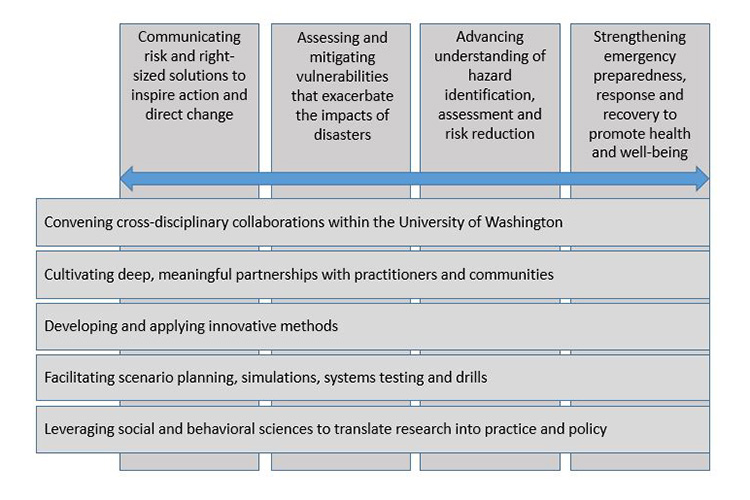
The Center for Disaster Resilient Communities’ research agenda is organized around four interconnected pillars. Five crosscutting mechanisms drive the operationalization of the Center’s research.
Focus areas
The CDRC research agenda is organized around four interconnected pillars, which are described in the following tabs.
The Center focuses on communication, implementation and decision support to increase resilience to hazards, especially around perceptions, uncertainty and probabilistic assessments of risk. Particular attention is devoted to identifying effective approaches that inspire people to take action for rare but devastating events such as megathrust earthquakes. This work draws heavily from social and behavioral sciences to take evidence-informed approaches to directing change.
The Center’s research pursues performance-based retrofitting strategies and policies to better mitigate vulnerabilities in the natural, built and social environment. The Center also looks globally to better understand how different cultures and social environments impact effective responses to hazards and disasters. A special focus is on communities where social conditions or vulnerabilities exacerbate disaster impacts.
The Center takes an integrated research, practice and educational approach that fosters ongoing learning about specific hazard and disaster scenarios such as earthquakes, tsunamis and wildfires. Our interdisciplinary understanding of natural hazards and resilience at multiple temporal and spatial scales, as well as different levels of governance, allows us to identify systems-level vulnerabilities while also working to develop extreme event and hazard early warning systems.
The Center works to build capacity within healthcare to adapt to disaster-related surges in patient demand. This healthcare system optimization includes approaches to system-wide coordination, staffing and standards of care that can be implemented during periods of high stress to the system. Our work also focuses on developing a research rapid response capacity to facilitate health-related research data collection during and after disaster events.
Mechanisms
The CDRC operationalizes our work through a focus on five mechanisms that support the themes of the research agenda. These mechanisms are described in the following tabs.
The Center is developing and nurturing a robust community of practice across the University of Washington’s three campuses that brings together disciplines ranging from engineering and the built environment to medicine and public health. We leverage our convening power to come together in cross-disciplinary ways around common strategic frameworks, which allows us to bridge linkage gaps – where the focus of one discipline ends and another begins – to more holistically design and implement research projects.
The Center plans and engages with communities as they work to become more resilient to disasters. We work collaboratively with locally-, regionally-, nationally- and internationally-based community and government partners to identify the key research questions they have and data and information they need to better prepare, mitigate, respond and recover from disasters. This community-driven approach to disaster research is grounded in a commitment to the equitable and mutually beneficial creation and exchange of knowledge.
The Center is exploring how to take newer approaches, such as machine learning and data science, and apply them to more traditional forecasting and modeling of natural hazards such as earthquakes, landslides, tsunamis, wildfires, windstorms and floods, among others.
The Center will work with community and government partners to integrate the latest science into regionally-focused disaster planning scenarios to facilitate planning and preparedness. Another area of interest is the development of a simulation approach for stress testing health systems for disasters, including compound hazards associated with climate change, and pilot the approach in different settings as a means of improving disaster resilience.
The Center focuses on improving communication among researchers, the public and private sectors and communities to better facilitate the uptake of research into practice and policy.