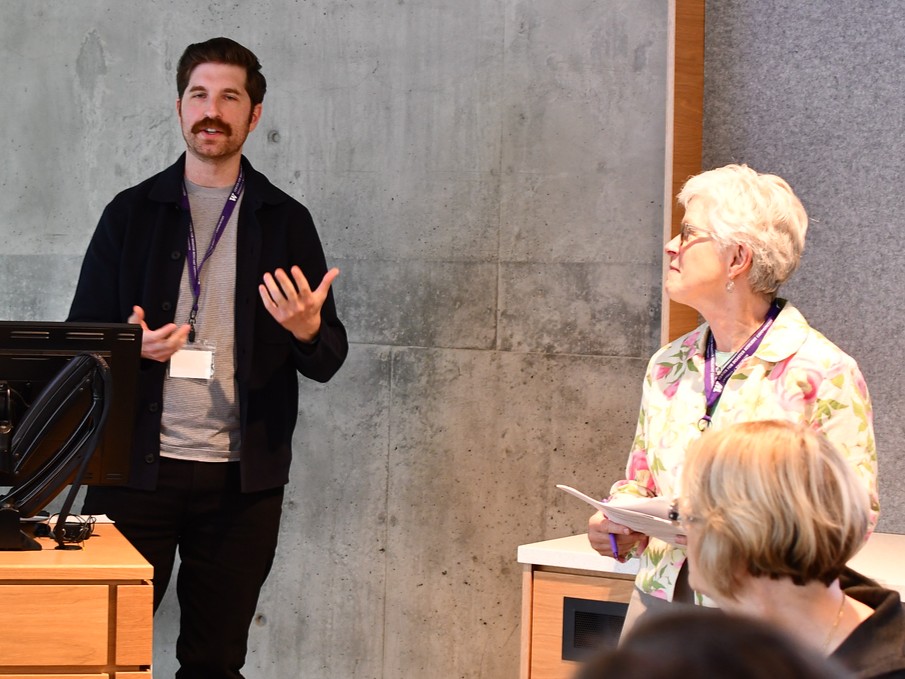
 “Mentorship and peer learning are like the holy grails of adult learning and public health training,” according to Kevin deVoss (pictured), an adult education specialist who helps lead the Dissemination Core of the Northwest Center for Evidence-Based Public Health Emergency Preparedness and Response (NWPHEPR) with Betty Bekemeier, Associate Director of the Dissemination Core.
Bekemeier and deVoss have worked together for many years with the team at the Northwest Center for Public Health Practice (NWCPHP) to provide training for public health professionals in the region.
“We noticed over the last few years that a lot of the members of the practice community that we support were saying ‘hey, I did this ‘ECHO’ peer learning session and it was really helpful for me. We were able to dive deeper into topics and have experts share their wisdom in a more intimate way,’” said deVoss.
Intrigued, deVoss and the NWCPHP team examined Project ECHO (Extension for Community Healthcare Outcomes), an approach initially developed for medical education by a team at the University of New Mexico. ECHO provides an infrastructure for knowledge sharing among local experts. “ECHO’s efficacy has been supported by the literature for many years,” said deVoss.
While deVoss, Bekemeier, and the NWCPHP team had previously done many individualized asynchronous online training and cohort-based programs, deVoss describes ECHO as more organic. “It tends to be more operated and sustained by the participants themselves, and it’s a way for participants to go to that next level of making connections with peers and colleagues in the field,” said deVoss.
In 2022, deVoss and the NWCPHP team got ECHO training through the National Network of Public Health Institutes (NNPHI) and the NWCPHP was certified to be an “ECHO hub.” Since then, the NWCPHP has led ECHO cohorts across Washington.
 Now they are working to connect public health professionals regionally by creating an ECHO cohort for the participants of the 2025 NWPHEPR’s Crisis Leadership Institute (CLI). Starting in February of 2026, the CLI cohort will participate in six 90-minute ECHO sessions separated by a month each. Each session will focus on a case study brought by a participant.
“There’s different pedagogical models that you can use to run a training program,” said deVoss. “Some programs bring in experts or have regular homework, and there can definitely be a place for that, but ECHO’s more about giving practitioners a space to share their own expertise and the incredible amount of knowledge that they bring.”
It is an approach that deVoss and the NWCPHP have found fruitful in the past. “Former participants have said that few other training programs offer the same level of learner-centered support or structure sessions around practitioner knowledge and a dedicated time to share among colleagues,” said deVoss.
Beyond connecting to peers regionally, ECHO connects participants to other efforts globally through what is known as iECHO and the Project ECHO Resource Library (PERL). “It’s all about disseminating expertise to the widest swath of professionals possible,” said deVoss. “They [NNPHI] don’t just encourage but require you to share materials that you offer to your cohort with the wider network.”
Feedback from the CLI in September suggested that participants wanted more time for discussion and more practice-centered cases and examples—something deVoss is excited to offer through ECHO. Feedback from the CLI will also provide baseline data for evaluation of the ECHO project.
NWPHEPR has formed a working group with representation from all its cores to help with the ECHO effort. Resham Patel and Naomi Cutler from the Dissemination Core will help identify expert participants to present, while Juliette Randazza from the Implementation Core will help with program evaluation. Kaitlin Brumbaugh and Theresa Sabala from the Administration Core will help with logistics, and representatives from the Tribal Working Group will help with dissemination.
“The fact that we’re able to do this is the direct result of having a really strong NWPHEPR with all of these talented people across our cores who are interested in delivering the best we can for this learning community,” said deVoss. Workforce capacity and leadership was the first priority focus area identified by the NWPHEPR’s Steering Committee. The ECHO Project is one evidence-based intervention aimed toward that end.
DeVoss is excited to see it come together for the CLI participants. “This is a really special group of people we’re working with. It includes folks from big teams, small teams, rural, urban, Tribal, non-Tribal. They’re doing amazing, interesting, and diverse work. It’s not common that you get the opportunity to bring together groups of professionals like this in public health,” said deVoss. “It’s going to be a pleasure to help facilitate.”