 Public health emergency preparedness has evolved significantly over the past decade, shaped by the COVID-19 pandemic, shifting workforce needs and a growing emphasis on equity and community resilience. However, the competencies that guide this workforce have not been updated in more than 10 years.
In response to these changes, researchers at the University of Washington have collaborated with practice and academic partners to produce an updated draft set of public health emergency preparedness and response (PHEPR) competencies for all public health staff and a new set of competencies specifically for public health preparedness staff.
We are now seeking the input from the public health practice and academic communities, as well as related partners, to refine this proposed set of PHEPR workforce competencies. We invite you to complete a short survey to provide feedback on PHEPR competencies that you consider most important. Professionals across emergency preparedness and response, higher education and related fields are encouraged to participate.
Share your expertise: complete the PHEPR competencies survey.
Project background
The field of public health emergency preparedness has changed significantly over the past decade, with evolving approaches and priorities shaped by lessons from the COVID-19 pandemic and shifts in the workforce. A growing emphasis on equity, community resilience and partnerships requires a workforce equipped to build and sustain these relationships. There is also an increasing need for specialized training for public health preparedness staff. Existing PHEPR competencies have not been updated in more than 10 years and may not fully reflect current workforce needs. This project builds on evidence-based practice to develop updated competencies that better align with the field today.
The University of Washington conducted a series of focus groups with local and state public health practitioners to explore updated PHEPR workforce competencies in the United States. These discussions identified seven key themes, with equity recognized as a cross-cutting priority (see figure).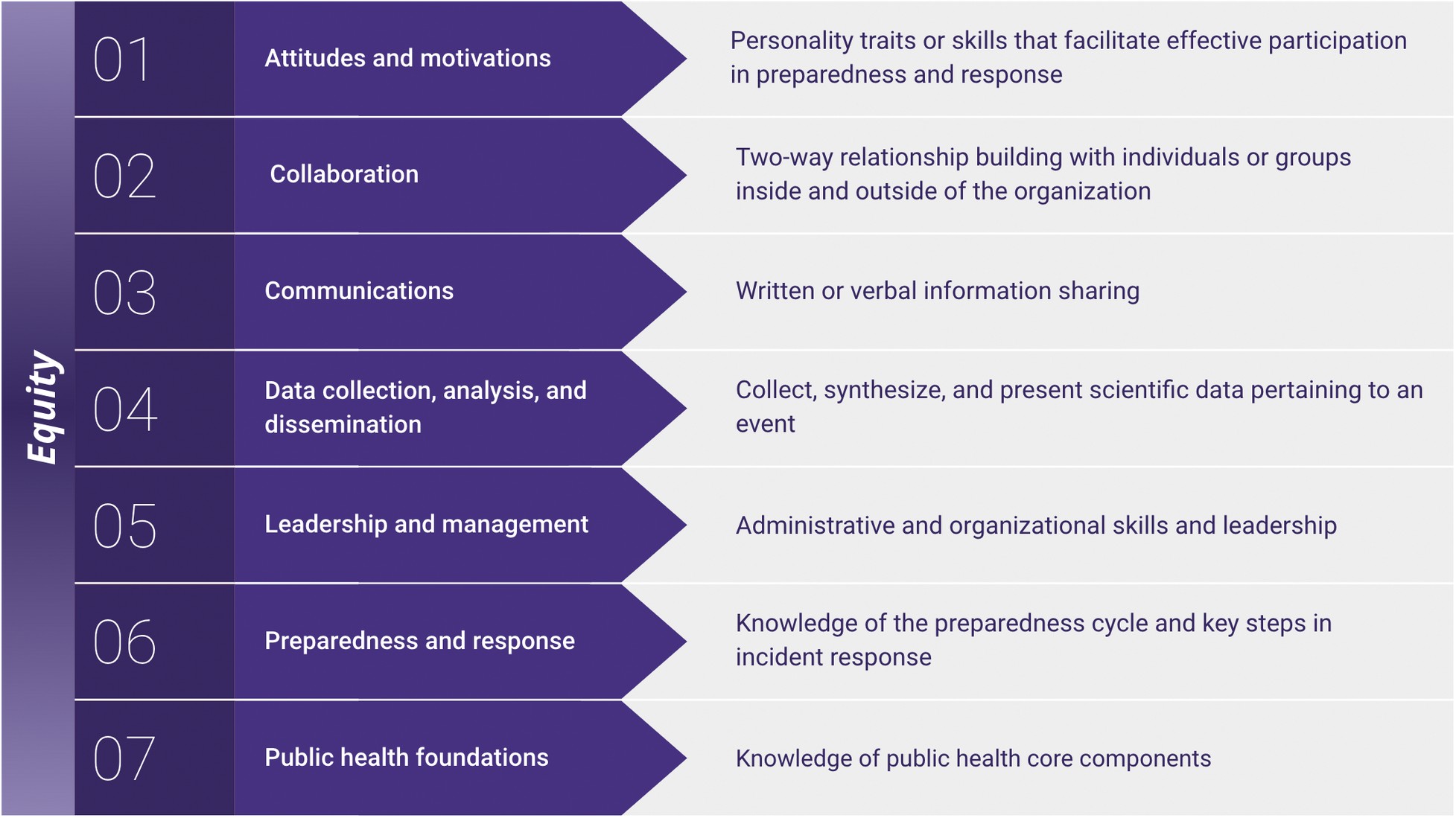
Insights from the focus groups were further refined by an expert working group that included representatives from national public health organizations, local health departments and universities. The proposed competencies were aligned with the 2010 PHEPR competencies and the Core Competencies for Public Health Professionals to ensure consistency and avoid duplication.
This process resulted in an updated set of PHEPR competencies for all public health staff, as well as a new, specialized set for public health preparedness professionals. These competencies are designed to support training programs, educational initiatives and broader workforce development efforts.
We invite professionals across the field to help shape the final set of competencies by completing a short 15-to-20-minute survey. The survey includes opportunities to suggest edits, refine language and propose additional competencies.
Thank you in advance for sharing your time and expertise. Please feel free to share this opportunity with colleagues who may also be interested in contributing.
If you would like to stay connected to this project, you can sign up using the interest form.