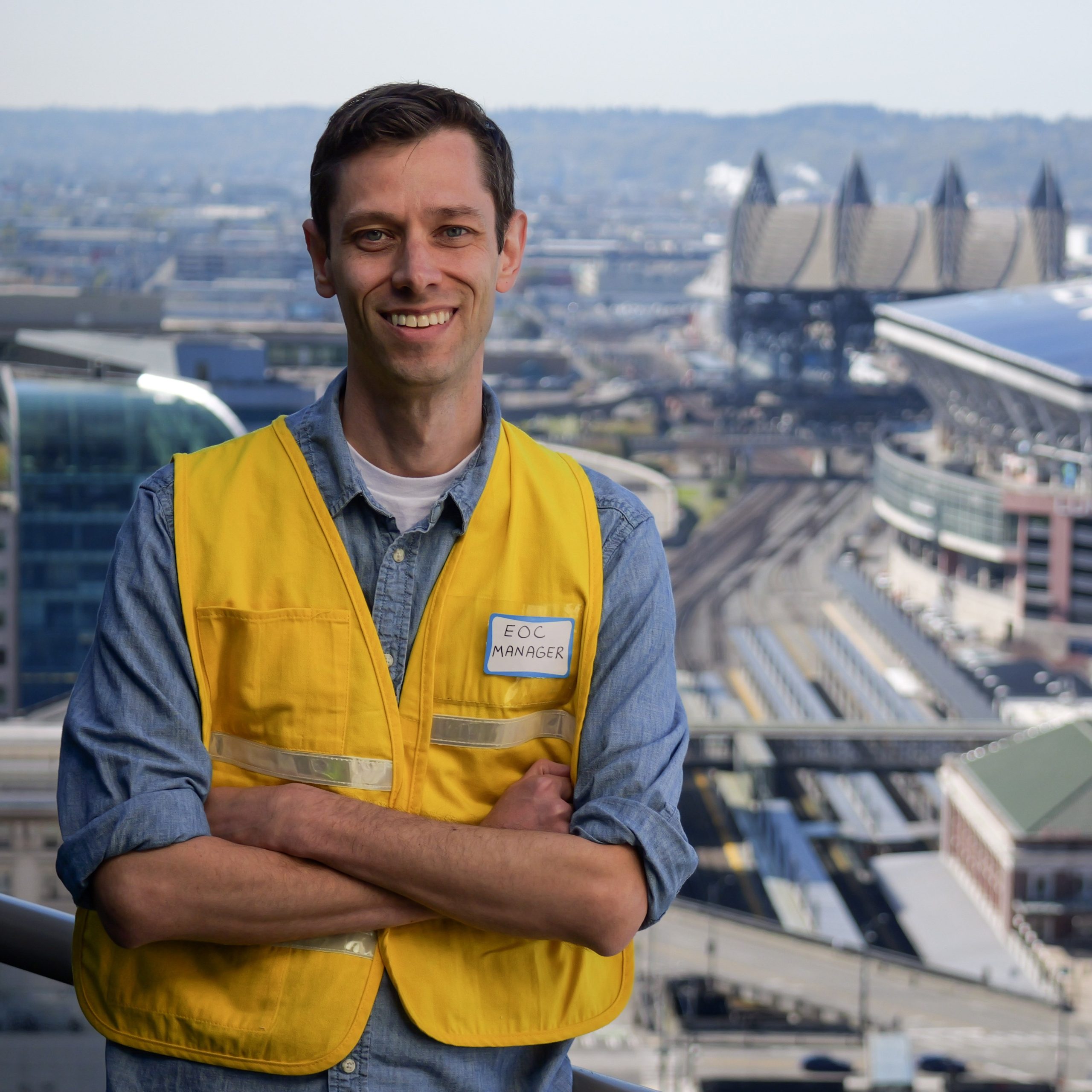
 The FIFA (International Association of Federation Football) World Cup soccer games are considered the biggest sporting event on the planet. FIFA projects that five million people will watch the 2026 games live while a total of six billion tune in globally. As one of 16 North American cities to host the games, Seattle is expected to receive 750,000 visitors for the event, almost doubling Seattle’s 2022 estimated population size of 762,500. From a public health emergency preparedness perspective, that’s a lot to plan for.
“I liken it to hosting six Super Bowls within three weeks,” said Nick Solari, Preparedness Director for Public Health – Seattle & King County (PHSKC) and a steering committee member for the Northwest Center for Evidence-Based Public Health Preparedness and Response (NWPHEPR). “But the Super Bowl has a U.S. audience, for the most part, and this is obviously a world audience.”
Solari supervises a team of 13 people who are responsible for ensuring that the city and county’s health department can effectively and equitably respond to emergencies. He has been actively preparing for the World Cup with partners across the city, county, state, and region since January of 2025.
Solari said his first thought when he heard that the World Cup was coming to Seattle was excitement as a sports fan. “If I wasn’t working, I would try to get tickets,” said Solari. “But it is not lost on me that when there are fun things like the Seahawks parade and other celebratory times for our communities there are folks behind the scenes that need to make sure things are safe, everyone stays healthy and everyone has a good time. That’s just part of my job now. There’s a lot we need to do to get ready.”
Efforts to date have focused on three priorities. The first is an internal focus on the continuity of operations. This involves planning for the traffic congestion, security precautions and changes to public transit that are expected leading up to, during and after the World Cup games. “It’s going to be harder for staff to get around. We want to make sure that we are sharing information about disruptions to travel as best we can, especially for 24/7 services like our Medical Examiner’s Office and jail health services,” said Solari. This also includes planning for potential protests.
The second priority is to plan for an increased demand in day-to-day services. “How are we preparing for, for example, doing additional inspections of food vendors that will pop up as watch parties and things like that get organized,” said Solari. There will also be a higher likelihood of disease outbreaks and a higher number of natural deaths, putting strain on the medical examiner.
Finally, the third priority is to plan for emergencies. Extreme heat is one possibility. “The World Cup is occurring on the five-year anniversary of the 2021 Heat Dome,” said Solari. “There is the possibility that we see extreme heat in June which could affect everyone in King County, regardless of whether they are participating in the festivities.” A second type of emergency would be a disease outbreak, which the team is planning for with the Washington Department of Health. The team is also planning on how to cope with a mass fatality incident, whether from a shooting, a car ramming or a stampede of people. In such a case, PHSKC’s Medical Examiner’s Office would be involved with death investigations, autopsies, and identifying, notifying and reunifying families with decedents.
While the City of Seattle drives the planning for the event through departments like PHSKC, the Department of Transportation and Human Services Department, planning also involves county-level offices like the King County Office of Emergency Management and statewide entities like the Washington State Department of Health and the Northwest Healthcare Response Network. Solari’s team also coordinates with other counties that are planning fan events like outdoor screenings and with other west coast cities that are hosting World Cup games like San Francisco, Los Angeles and Vancouver, British Columbia.
Early in his career, Solari wouldn’t have seen himself preparing a major city for a World Cup soccer tournament. His path to his current role has been circuitous. Solari grew up near Atlanta, Georgia and majored in political science at the University of Georgia before obtaining a masters in public administration from the same university. He then joined AmeriCorps with Tulane University’s Center for Public Service where he assisted with recovery from Hurricane Katrina in the Mayor of New Orleans’ Office of Constituent Services.
In 2012, Solari moved to Boston and took a job managing the Medical Reserve Corps for the Boston Public Health Commission. In that role, he dealt with everything from preparations for Hurricane Sandy to the Boston Marathon bombings to the snowiest winter on record for Boston, in the winter of 2014-2015. “I think they had 108 inches of snow,” said Solari. “So that was me sleeping on cots in the office, waiting for the blizzards to knock out power, monitoring the status of hospitals and healthcare.”
After that experience, Solari decided he was done with snow and took a job with PHSKC in 2015, starting as an emergency response planner, focused on how to get vaccines and antibiotics to impacted populations in the case of an epidemic or act of bioterrorism. In 2018, he became the Response Planning and Partnerships Manager for PHSKC and set up their first incident management structure for COVID in January of 2020. “I did everything from help open up our call center to open up some of the first vaccine clinics in the county when vaccines were still super scarce,” said Solari.
Solari is not the only public health preparedness professional to have had a circuitous path. The NWPHEPR helps Solari and others with varied backgrounds implement evidence-based preparedness in their current roles. Its initiatives, such as the Crisis Leadership Institute, provide opportunities for those who find themselves in public health preparedness roles to gain relevant knowledge, skills and abilities to help lead their agencies effectively.
Three years ago, Solari was promoted to PHSKC’s Preparedness Director. He currently oversees a team that writes plans; makes sure that the agency has enough staff, supplies and facilities; organizes and evaluates trainings and exercises; and coordinates with partner groups, including emergency management and healthcare. Two years ago, his team worked with community partners to start a Community Advisory Group that advises this work. “We live in an increasingly complex world, and my team does really inventive and collaborative work to make sure our department is ready to respond to different types of disasters,” said Solari.
Heading into the World Cup, Solari’s team will be temporarily increasing staff so that they can open a department operations center with an incident management structure from June 8th—a week before the first game—until July 13th—a week after the last game. “On match days themselves, our department operations center will be open and we’ll be holding additional briefings for staff, making sure we’re all on the same page and making sure we have information we can report to the City of Seattle and King County Office of Emergency Management regarding any health, medical or mortuary impacts that we are seeing,” said Solari. Partner organizations will have their own Emergency Operations Centers and PHSKC will send liaisons to those as well. “We’re talking 40 people in a room for the City of Seattle, for example,” said Solari.
In the end, Solari says success will be being prepared to manage something that’s out of their control in a way that’s effective and equitable. “These are considerations that we always have in mind and always take to heart—how are we meeting folks where they are, depending on their needs, and how are we focusing our emergency response on populations that have historically been disproportionately impacted by emergencies.”